How to Use MAC Cards in Coaching: A Complete 5-Step Session Guide
Using MAC cards in coaching can turn a stuck conversation into a moving one in a matter of minutes. A client who has been circling the same explanation for twenty minutes picks up an image of a half-open door — and suddenly says the thing they had not said yet.
But metaphorical associative cards only work well inside a clear structure. This guide walks you through a complete MAC coaching session, from preparing the space to closing with a concrete next step. You will find a 5-step session structure, six card layouts, a bank of more than 40 coaching questions, a sample session script, and practical advice for online and group coaching. New to MAC cards? Start with What Are Metaphorical Associative Cards? A Beginner’s Guide.
Key takeaways
- MAC cards in coaching work through projection: the client, not the coach, gives each card its meaning.
- A clear 5-step structure — question, draw, explore, shift, next step — keeps a card session focused.
- Six simple layouts cover check-ins, obstacles, decisions, transitions and values.
- Your role is to ask open questions, never to interpret.
- Always close on a card that leaves the client resourced, with one concrete next step.
Table of Contents
Why MAC cards work in coaching
Metaphorical associative cards work through projection: faced with an open, ambiguous image, a client fills the gaps with their own experience. What they describe is never really the card — it is their situation, seen from a slight distance.
That distance is what makes MAC cards in coaching so effective. Talking about “the figure on the bridge” feels safer than talking about yourself, so clients reach difficult material sooner and with less resistance. Images also bypass the rehearsed, logical story a client has told many times, and they give a visual language to feelings that are hard to name.
- Faster access: clients often reach the core issue in minutes rather than sessions.
- Client ownership: the meaning comes from them, which supports autonomy — a core principle of coaching.
- Memorable insight: an image is easier to remember than a conversation, so the insight lasts beyond the session.
When to use MAC cards in coaching (and when not to)
MAC cards are especially useful when a client is:
- stuck, circling the same explanation or unable to see options;
- facing a decision or a career transition;
- finding it hard to name what they feel;
- working on values, identity or purpose;
- in a group or team setting where you need an equal, low-pressure way in.
They are less suitable when a client is in acute crisis or distress, when the client does not want to use them, or when the topic needs a specialist rather than a coach. In those moments, put the cards away — the relationship always matters more than the tool.
Before your MAC coaching session
Choose the right deck for the conversation
When you use MAC cards in coaching, different decks open different doors. A deck of emotional states helps a client name what they feel; a deck of paths and crossroads helps with decisions; a darker deck gives permission to talk about loss and endings. If you have one deck, that is enough — but match it to the topic when you can.
Prepare the space
- In person: clear a table, have the deck shuffled, and keep paper and pen nearby so the client can note what comes up.
- Online: have single card images ready to share on screen, or number your cards so the client can choose a number for a blind draw.
- Allow time. A single card can easily fill fifteen minutes of good conversation — don’t squeeze it into the last five.
Contract for the cards
Before you draw, explain the tool in one or two sentences: “These cards have no fixed meaning. I’m not going to interpret them for you — whatever you see is what matters, and you can always pass.” This sets expectations, lowers anxiety, and makes it clear that the client stays in charge of the meaning. It is also the step most often skipped when coaches start using MAC cards in coaching.
A 5-step structure for using MAC cards in coaching
This flow works for a dedicated card session or for a 20-minute segment inside a regular coaching conversation.
1. Set the question
Help the client put their topic into one open question. “What do I need to understand about my role at work?” works better than “Should I quit?” — open questions leave room for the image to say something new.
2. Draw the card
Decide together how to draw. Face-up: the client looks through the deck and chooses the image that speaks to them — this tends to show what they already feel. Face-down: the client draws blind — this often surprises, and cuts through a rehearsed story. Both are valid; you can also use one of each.
| Face-up (chosen) | Face-down (blind) | |
|---|---|---|
| Best for | Naming what the client already feels | Surprise, fresh perspective, cutting through a rehearsed story |
| Typical prompt | “Choose the card that shows how this feels.” | “Draw a card and tell me what you see.” |
| Watch out for | Clients choosing the “nice” card | A card that feels irrelevant at first — stay with it |
3. Explore the image
This is the heart of the session. Move slowly from what is visible to what it means for the client:
- Describe: “What do you see?” Let them describe the card in their own words before any interpretation.
- Feel: “What do you feel when you look at it?” Notice body language and pauses.
- Connect: “Where is this in your life right now?”
- Deepen: “What is happening just outside the picture? What happened before — and what comes next?”
Your job here is to stay curious and ask, never to interpret. If you notice something in the card that the client hasn’t mentioned, you can offer it as an observation — “I notice the light is coming from behind” — and let them decide whether it means anything. This is the single most important skill when working with MAC cards in coaching.
4. Find the shift
Most good card sessions reach a moment of change: a new perspective, a name for a feeling, a recognition. Help the client hold on to it: “What is different now compared to when we started?” or “What does this card know that you didn’t say earlier?”
5. Close with a next step
End by moving from insight to action. “What is one small step you could take this week?” Some coaches ask the client to draw one last card as a “resource” — something to take with them. Always close on a card that leaves the client resourced rather than raw: if the session went somewhere heavy, finish with a lighter or more hopeful image.
A sample MAC coaching session
Here is what a short exploration can sound like. The client, a team lead, came in wanting to “sort out” whether to apply for a promotion.
Coach: Let’s put your topic into one question.
Client: What is really stopping me from going for this role?
Coach: Draw a card face-down whenever you’re ready. What do you see?
Client: A door standing on water. There’s no path to it.
Coach: What is it like, looking at that door?
Client: It’s open, which is strange. I thought it would be locked. It’s the getting there that’s the problem.
Coach: Where is that in your situation?
Client: The job is open to me. I just don’t know how to cross — I’ve never managed managers.
Coach: What could help you cross?
Client: Talking to someone who has done it. I’ve been avoiding asking.
Coach: What is one step you could take this week?
Client: Book a coffee with Maria.
Notice what the coach did not do: there was no interpretation of the door, no advice about the promotion, and no leading question. The image did the heavy lifting, and the client arrived at their own next step in a few minutes.
Six MAC card layouts for coaching
These six layouts cover most situations in which MAC cards in coaching are useful. Start with the simplest one that fits the question — you can always add a card later.
One card: the check-in
“Choose a card that shows how you are arriving today.” A quick, powerful opener for individual sessions and groups alike. It often tells you more in two minutes than ten minutes of small talk.
Three cards: now · obstacle · resource
- Card 1 — Where am I now?
- Card 2 — What is in the way?
- Card 3 — What can help me?
This layout gives a complete mini-arc and naturally leads to action. Draw the first card face-up, and the second and third face-down for an element of surprise.
Two paths: the decision layout
For a client choosing between options: lay one card for each path, then one card for “what I really want”. Explore each path card separately before bringing in the third. Clients are often surprised by which path the “what I want” card seems to belong to.
Past · present · future
Three cards for “where I have come from”, “where I am” and “where I am heading”. Ideal for career transitions and life changes, and a gentle way to show a client how far they have already travelled.
The five-card journey
Five cards laid in a line: what is happening, what is underneath it, what is being held, what is already turning and what is ahead. This layout gives a complete arc from situation to direction — best in a longer session, and always explored card by card.
Image + word: the values pairing
Ask the client to choose one image card and then one word card that belongs with it — for example a picture of a lighthouse paired with the word “safety”. The combination often names a core value more precisely than either card could alone.
A question bank for MAC cards in coaching
Opening
- What would you like to look at today?
- What would make this session worth your time?
- Which card shows how you are arriving today?
Exploring
- What is the first thing you notice?
- If you were in this picture, where would you be?
- What is the person (or object) in the card feeling?
- What is not visible in this card, but you sense is there?
- What does this remind you of?
Shifting
- What would you change in this picture if you could?
- What would this card say to you if it could speak?
- What do you know now that you didn’t know when you drew it?
Closing
- What will you take away from this card?
- What is one small step you could take this week?
- How will you know you’ve taken it?
Beyond the four stages, it helps to have questions ready for the topics that come up most often in coaching.
Questions for goals
- Which card shows where you want to be?
- What does the person in this card have that you want?
- What is the first step on the path in this picture?
- How will you know you have arrived?
- What might the card show if you look again in six months?
Questions for values
- Which card feels most like “you at your best”?
- What is being protected or cared for in this image?
- Which word card belongs next to this picture?
- What would you never want to lose from this scene?
- Where in your week does this card show up?
Questions for change and transitions
- What is being left behind in this card?
- What is arriving?
- What does the in-between moment in this picture feel like?
- What do you need to take with you?
- Who or what could help you cross?
Questions for when a client feels stuck
- What is holding this scene in place?
- If one thing in the card moved, what would it be?
- What would the smallest possible change look like?
- Choose a card that shows “unstuck”. What is different?
- What does the stuck part of you want me to know?
Questions for relationships
- Which card shows this relationship as it is today?
- Where are you in this picture — and where is the other person?
- What is the distance between you in this card?
- What does this card show that you have not said to them?
- Which card shows the relationship you would like?
Questions for confidence
- Which card shows you at your most capable?
- What strength does the figure in this card have?
- When have you been in a scene like this before — and handled it?
- What would you tell the person in this card?
- What would change if you believed this card was about you?
When things don’t go to plan
Even experienced coaches meet these moments when using MAC cards in coaching. Here is how to handle the most common ones.
- “I don’t see anything.” Slow down. Ask for colours, shapes, the first word that comes to mind. Or invite them to swap the card for one they like better — or one they dislike most.
- The client explains instead of feeling. Gently bring them back to the image: “Let’s stay with the picture for a moment. What is happening in it?”
- Strong emotion comes up. Pause, slow your pace and give space. The card has done its job — you don’t need to push further. Close on a steadier, more resourced card.
- You feel the urge to interpret. Turn the thought into a question: instead of “This looks like loneliness”, ask “How does the figure in this card seem to you?”
Common mistakes to avoid
- Interpreting the card for the client. The moment you say what a card means, it becomes your session, not theirs.
- Rushing to the next card. One card explored deeply is worth more than five cards skimmed.
- Using too many cards too soon. Start with one or three; larger layouts can overwhelm a new client.
- Skipping the contracting. Without a short explanation, some clients assume the cards are fortune-telling.
- Ending on a heavy image. Always close with a card that leaves the client resourced.
- Forgetting the action. Insight without a next step rarely changes anything.
Using MAC cards in online coaching
MAC cards in coaching work very well over video. Share one card image at a time, full-screen, so the client can really look at it. For a blind draw, number your cards and ask the client to choose a number. Keep the pace slower than in person and check in more often, since you can read less body language on screen.


MAC cards in group and team coaching
Using MAC cards in coaching groups and teams works because an image gives everyone an equal starting point — the quiet participant and the confident one both begin by describing a picture.
- Check-in round: “Choose a card that shows how this project feels to you right now.” Each person shares in one or two minutes.
- Team retrospective: draw three cards for “what worked”, “what got in the way” and “what we want next time”.
- Vision work: each person chooses a card for “our team a year from now”, then the group looks for common themes.
- Ground rules: sharing is voluntary, nobody interprets someone else’s card, and what is said in the room stays in the room.
Ethics and scope
MAC cards are a reflective and facilitation tool. They are not a psychological assessment or diagnostic instrument, and they are not a substitute for therapy or medical care. Work within your own training and scope of practice, follow your professional code — for example the ICF Code of Ethics — and refer a client on if a session opens something that needs specialist support.
Keep a record of every card session
Insights from MAC cards in coaching sessions fade quickly if nobody writes them down. After each session, note the question, the cards drawn (by name or number), the client’s own words about each card, the shift they noticed and the next step they chose. Over several sessions, patterns start to appear — the same image chosen three times, or a card the client always avoids — and those patterns are valuable material for future coaching.
A simple session record sheet also helps you stay accountable to your contracting and makes supervision conversations easier.
Which MAC cards to use in coaching
- Inner Weather — for naming feelings and emotional states.
- Undercurrent — for grief, endings and the conversations that are not light.
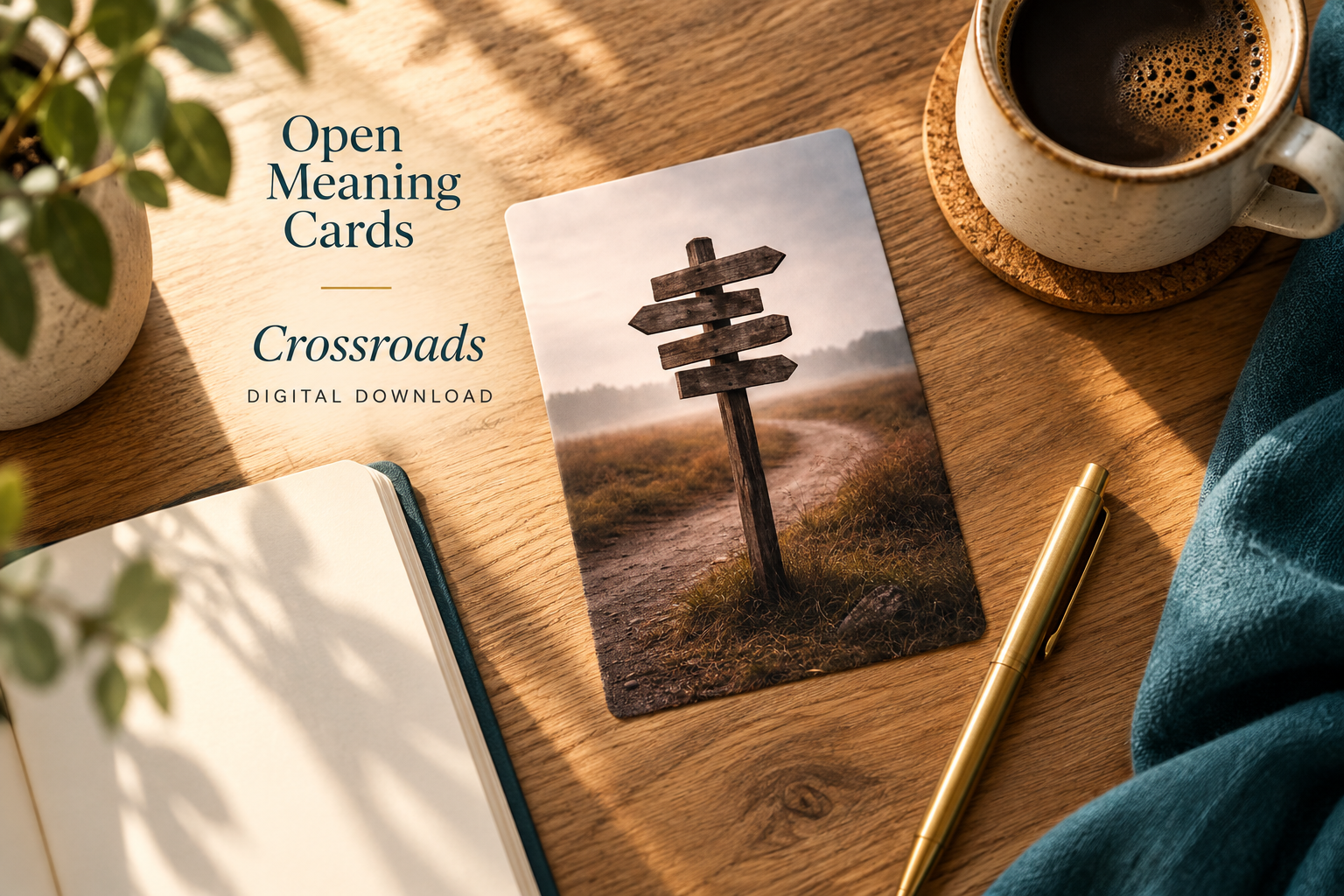
- Crossroads — for decisions and clarity, perfect for the two-paths layout.
- Words — fifty feelings, needs and values words to draw alongside any image deck.
If you are just starting with MAC cards in coaching, choose one deck that matches your most common client topics. Each coaching deck comes with a full facilitator guide: card layouts, a coaching framework with scripted language, a question bank, and a troubleshooting section — so you can run your first session with confidence. The image decks share the same card size, so you can combine them as your practice grows.
Frequently asked questions about MAC cards in coaching
How long should a MAC card coaching session take?
A single-card exploration usually takes 10–20 minutes. A full three-card session fits comfortably into a 50–60 minute coaching session, and a five-card journey works best in a longer 75–90 minute session or across two meetings.
Should the client choose the card or draw it blind?
Both work. Choosing face-up shows what the client consciously feels; drawing face-down brings in surprise and often bypasses overthinking. Many coaches use one of each in the same session.
Do I need special training to use MAC cards in coaching?
No formal certification is required. What matters is solid coaching skill: open questions, active listening and never interpreting the card for the client. A facilitator guide with layouts and scripted language makes the first sessions much easier.
Can I use MAC cards with groups and teams?
Yes. Spread the cards face-up and ask each person to choose one for a check-in or reflection question. Keep sharing voluntary, set a time limit per person, and close the round with a shared question such as “What did you notice across all the cards?”
Can MAC cards be used in online coaching?
Yes. Share one card image at a time on screen, or number your cards so the client can pick a number for a blind draw. Slow the pace a little and check in more often than you would in person.
What is the difference between MAC cards and tarot in coaching?
Tarot has a fixed system and traditional card meanings. MAC cards have none: the client is the only authority on what a card means. That is why MAC cards fit professional coaching — they open a conversation without predicting, advising or diagnosing.
Do I need to be a therapist to use MAC cards?
No. Coaches, teachers, facilitators and HR professionals use MAC cards widely. The key is to stay within your own scope of practice, never use the cards to diagnose, and refer a client on if a session opens something that needs specialist support.