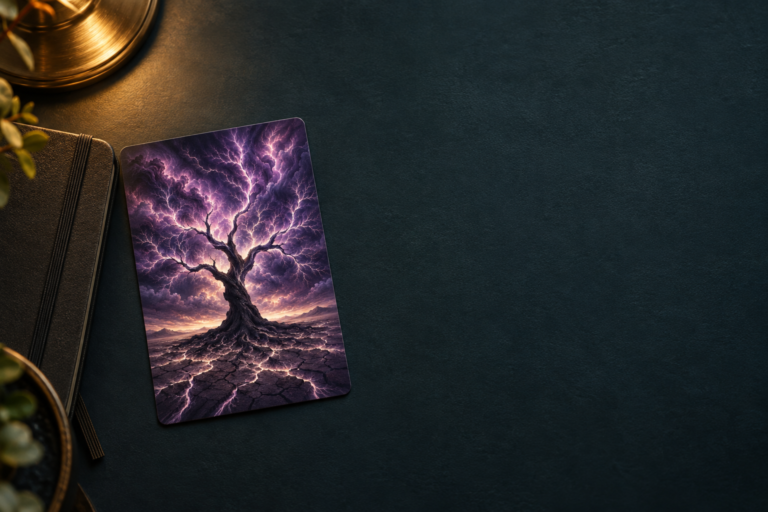
30 Self-Reflection Questions to Use With Any Card Deck
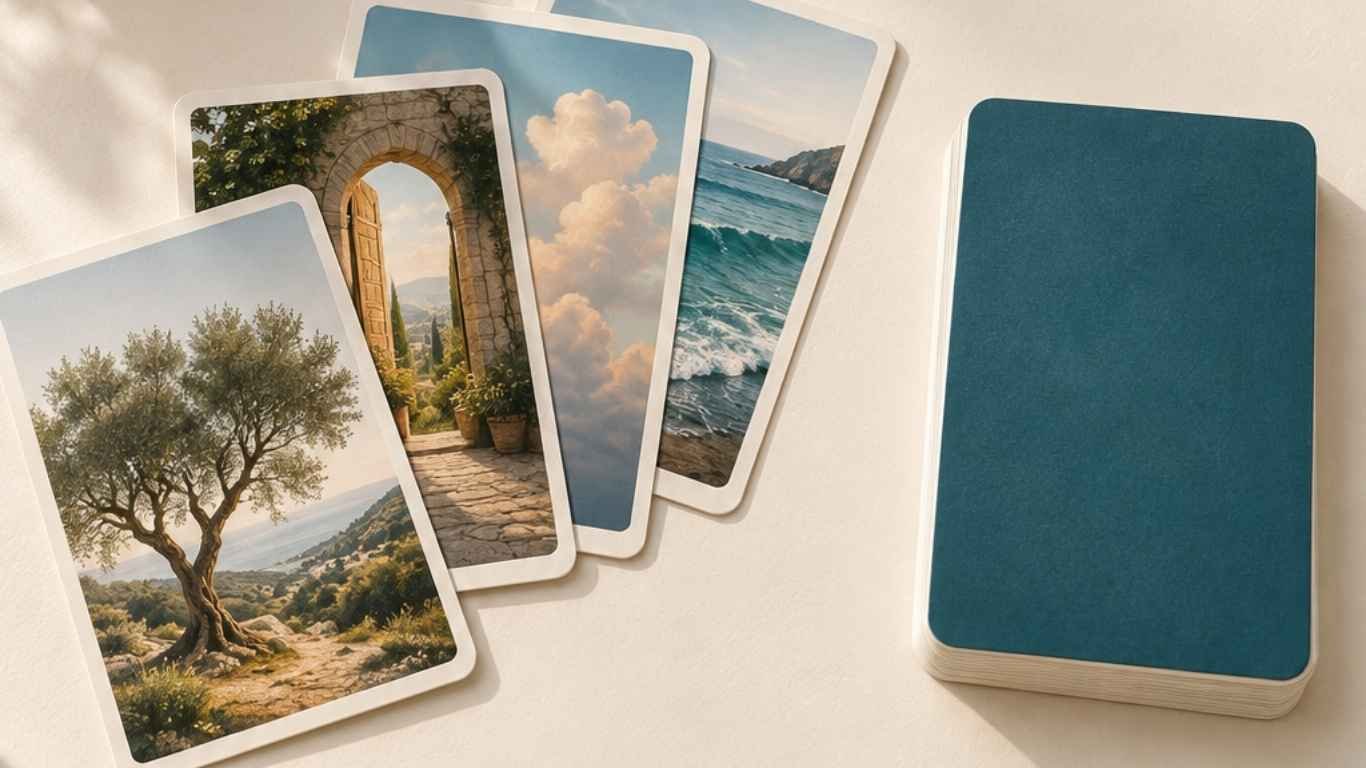
By Open Meaning Cards · Published September 2026
Good self-reflection questions are open, specific and impossible to answer with a yes or a no. They do not ask you to judge yourself; they ask you to look. Paired with a card deck — picture cards, word cards, any deck with no fixed meanings — a single question can reach something a whole evening of thinking usually misses.
This article gives you thirty of them, grouped into six themes: where you are now, feelings, values, relationships, change and decisions, and the future you want. You will also find a three-step way to use a question with a card, a ten-minute journaling routine, a worked example, and the mistakes that quietly make reflection less useful. Take one question, not all thirty.
Key takeaways
- The best self-reflection questions are open, present-tense and free of judgement — they invite description, not a verdict.
- A card adds distance: you describe the image first, then notice what it says about your own situation.
- Thirty questions, six themes — use one at a time rather than working through the list.
- Ten minutes, one card and one question is a complete practice. Longer is not better.
- The pause after the question matters more than the answer you write down.
[Rank Math Table of Contents block]
What makes a good self-reflection question
Most questions we ask ourselves are disguised judgements. Why am I so bad at this? is not a question; it is a verdict with a question mark. It has one available answer, and you already know it.
A useful self-reflection question does three things instead. It stays open — it cannot be closed with yes, no or a number. It stays specific — “What drained me this week?” gives you somewhere to start, while “How is life?” gives you nothing. And it stays curious rather than evaluative: it asks what is true right now, not whether that is good enough.
There is one more quality that is easy to miss. A good question leaves room for an answer you did not expect. If you can predict what you will write before you pick up the pen, the question is probably too safe. The questions below are deliberately phrased to make the predictable answer slightly harder to reach. This is the everyday version of reflective practice, the habit of examining your own experience in order to learn from it.
How to use these self-reflection questions with a card
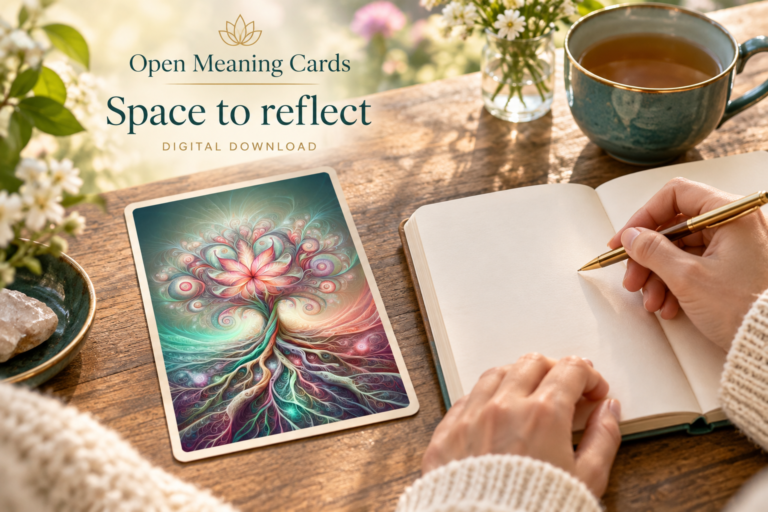
You can answer any of these questions with a blank page. A card deck simply makes the answer arrive sooner, because an image gives you something to describe before you have to say anything about yourself.
Picture cards work through projection: faced with an open, ambiguous image, you fill in the gaps with your own material. What you notice in the picture — the door standing half open, the figure with their back turned, the light coming from behind — is rarely about the picture. If this idea is new to you, What Are Metaphorical Associative Cards? explains how the mechanism works.
Three steps, whichever deck you own:
- Ask the question first, then draw. Read the question, say it out loud if you can, and only then turn a card face up. Ask first and the card has something to answer.
- Describe the card before you interpret it. Write two or three sentences about what you actually see — colours, weather, what is near, what is far away, what is missing. Stay with the image longer than feels necessary.
- Cross over to your own life. Then ask: where is this in my life right now? The crossing point is where the reflection happens, and it usually arrives in one sentence rather than a paragraph.
If you draw a card that seems irrelevant, do not swap it. “This has nothing to do with my question” is itself worth writing down — and it changes surprisingly often once you have described the image properly.

30 self-reflection questions by theme
Six themes, five questions each. Read the group that matches where you are, pick the one question that makes you slightly uncomfortable, and leave the rest for another day.
Where you are now (1–5)
- What is taking up the most space in my mind this week?
- If this period of my life were a season, which one would it be — and what is the weather like?
- What am I spending energy on that nobody has actually asked me to do?
- What has quietly changed in the last six months that I have not stopped to notice?
- What am I carrying that is not mine?
Questions about feelings (6–10)
- What feeling has been closest to the surface lately, and where do I notice it in my body?
- What am I feeling that I have not yet said out loud to anyone?
- When did I last feel genuinely at ease — and what was present that day?
- What is the feeling underneath the irritation?
- If this feeling could speak in one sentence, what would it ask me for?
Questions about values (11–15)
- What did I do this month that I would do again even if nobody knew about it?
- When do I feel most like myself — and what am I usually doing at the time?
- What am I tolerating that quietly goes against something I care about?
- Whose approval am I still working for, and is it worth the cost?
- If I had to protect only three things in my life for the next year, what would they be?
Questions about relationships (16–20)
- Who do I feel most myself around, and what do they do that makes that possible?
- What do I need from the people close to me that I have never directly asked for?
- Which relationship am I maintaining out of habit rather than warmth?
- What am I not saying in order to keep the peace — and what is that costing me?
- Where am I giving more than I can sustain, and what would a fair version look like?
Questions about change and decisions (21–25)
- What decision have I already made but not admitted to myself yet?
- What am I waiting for, and who is it that has to give permission?
- If I knew this situation would be exactly the same in two years, what would I do today?
- What is the smallest step that would still count as movement?
- What would I have to let go of for this change to be possible?
Questions about the future you want (26–30)
- What do I want more of — described concretely enough that I would recognise it if it arrived?
- What would an ordinary Tuesday look like in the life I am working towards?
- What do I want to be true in a year that is not true now?
- What am I hoping someone else will decide for me?
- What is one thing I could stop doing that would make room for the rest?
A 10-minute journaling routine with a card
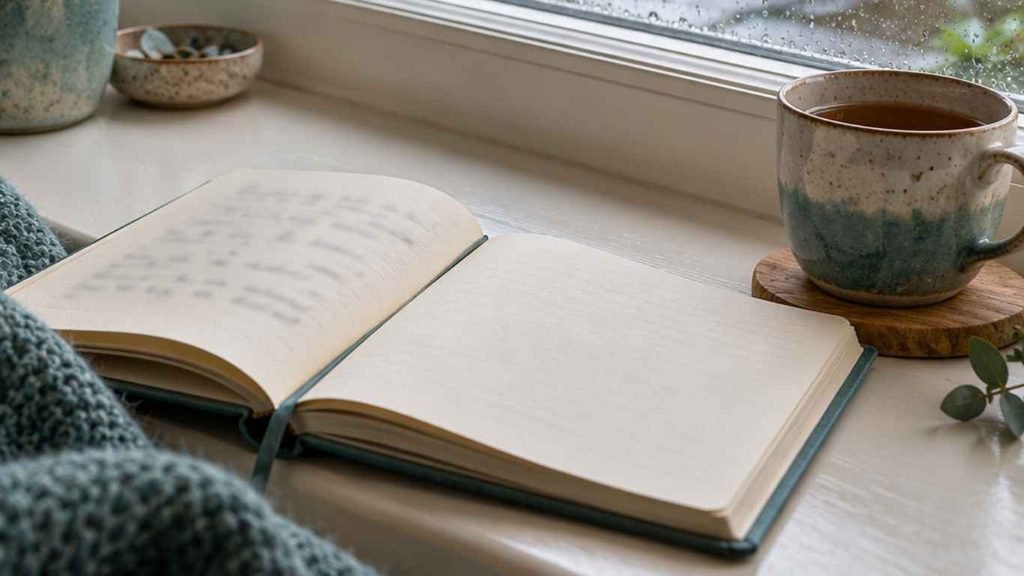
Self-reflection questions work best with a short, repeatable routine rather than a long occasional session. This one takes ten minutes and needs a deck, a notebook and a timer.
- Minute 0–1 · Settle. Put the phone face down. Take three slower breaths. Choose the theme you need today.
- Minute 1–2 · Ask. Write the question at the top of the page and read it once more.
- Minute 2–3 · Draw. Turn one card face up, or fan the deck face up and choose the image that pulls at you. Blind draws surprise you; chosen cards show what you already feel. Both are valid.
- Minute 3–5 · Describe. Write what you see, in plain words, without meaning. What is in the foreground? What is just outside the frame? What is missing?
- Minute 5–8 · Cross over. Answer the question with the card in front of you. Write without stopping and without editing.
- Minute 8–9 · Name the shift. One sentence: what do I know now that I did not know ten minutes ago?
- Minute 9–10 · One small step. One concrete action for the next seven days. Small enough to be certain, specific enough to be checked.
Keep the card beside you for the rest of the day if you can — on the desk, in a book, photographed as your lock screen. The image keeps the question alive far longer than a written note does.
A worked example
Here is what a short entry can look like. The question is number 21: What decision have I already made but not admitted to myself yet?
The card: A long wooden pier going out over grey water. It ends in air — no railing, no boat, no land on the other side. There is light at the horizon but it is behind the fog, not on it.
Crossing over: I have been calling this “thinking about whether to leave the team”. But the pier is already built. I have walked most of it. What I actually don’t know is what happens at the end — not whether to walk.
The shift: The decision is made. The unknown is the landing, not the choice.
Small step: Ask R. how she handled the first month after she moved, this week.
The card said nothing about work. It also did not predict anything. It simply held the shape of the situation — built, walked, unfinished at the end — long enough to be recognised.
Common mistakes with self-reflection questions
- Using too many questions at once. Thirty questions in one evening produces thirty shallow answers. One question, ten minutes, done properly, will outperform the whole list.
- Judging the answer as it arrives. The moment you start grading what you wrote, the writing stops being honest. Describe first; evaluate later, or not at all.
- Skipping the pause. The useful material usually turns up three or four seconds after you think you have finished. Sit in the silence before you write the neat answer.
- Swapping the card you drew. A card that “doesn’t fit” is information. Describe it before you reject it.
- Reaching for a meaning book. No deck used this way has fixed meanings — not the picture cards, not the word cards. The only authority on what a card means is you.
- Turning reflection into another performance. No streaks, no perfect notebook, no daily obligation. Three good sessions a month beat thirty resented ones.
When a question opens something difficult
Sometimes a question reaches further than expected, and that is not a failure of the practice. Close the notebook, put the card down and do something ordinary and physical — a walk, washing up, a phone call to someone kind.
A card deck and a set of self-reflection questions are a reflective tool, not a psychological assessment, a diagnostic instrument or a substitute for therapy or medical care. If something keeps returning, or feels heavier than you can hold on your own, that is worth taking to a therapist or a doctor — not to a deck. If you work with clients rather than only yourself, How to Use MAC Cards in Coaching covers the structure, the ethics and the limits of the tool in professional sessions.
Which deck to use with these questions
Any deck with open images works. If you are choosing one for this kind of reflection, match the deck to the theme:
| If you are working on | Deck | Why |
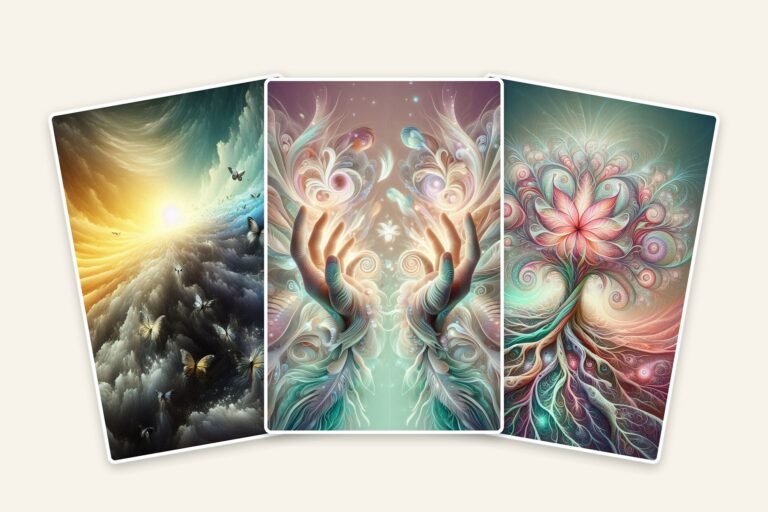
| Open reflection, creativity, insight | Surreal & Fractal | Deliberately strange images that cannot be filed away in a second — good for questions 1–5 and 26–30 |
| Feelings vocabulary, values, needs | Words | Fifty plain words to land on when a picture opens more than it closes — pairs with any image deck |
| Naming feelings, daily check-in | Inner Weather | Images of states rather than scenes, which makes questions 6–10 unusually direct |
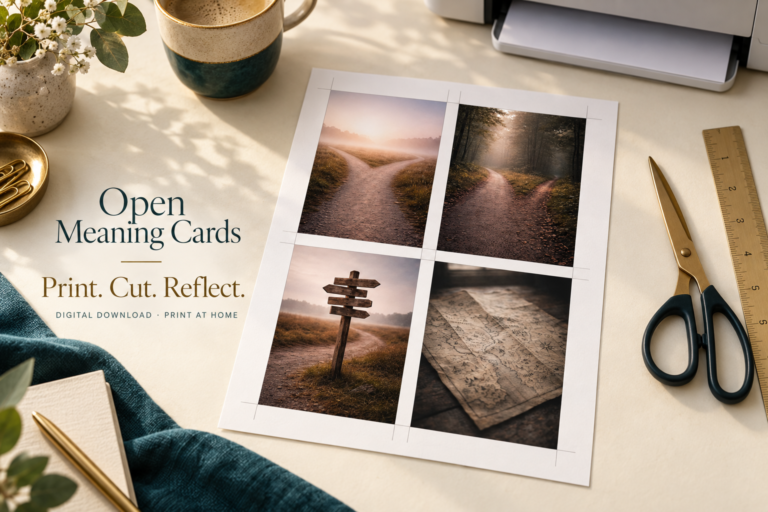
| Decisions, crossroads, clarity | Crossroads | Paths, doors, thresholds — built for questions 21–25 |
| Endings, loss, transitions | Undercurrent | Darker imagery that gives difficult material permission to be looked at |
A simple pairing works well: draw one picture card, then one word card, and ask how they speak to each other. Explore the card decks to see which one fits the questions you keep returning to.
Frequently asked questions
What are good self-reflection questions?
Good self-reflection questions are open, specific and free of judgement — they ask what is true right now rather than whether it is good enough. “What am I tolerating that goes against something I care about?” is a self-reflection question; “Why am I so disorganised?” is a verdict. The best ones leave room for an answer you could not have predicted.
How often should I do self-reflection?
Once a week is enough for most people, with a longer session at the end of a month or a season. Consistency matters more than frequency: ten honest minutes on a Sunday will do more than a daily habit you resent by week three.
Can I use these questions without cards?
Yes. Every question here works with a blank page. A card simply gives you something concrete to describe first, which makes the honest answer arrive sooner and with less resistance — especially on days when you do not feel like writing about yourself.
How do I journal with a picture card?
Ask the question first, then draw a card. Describe what you see in plain words for two or three minutes before assigning any meaning. Then ask where that image lives in your current situation, and finish with one sentence about what changed and one small step for the week.
What if a question brings up difficult feelings?
Stop, close the notebook and do something grounding and ordinary. Difficult material is a signal to slow down, not to push harder. If it keeps returning or feels too heavy to hold alone, take it to a therapist or another qualified professional rather than to a deck.
Are self-reflection questions the same as journal prompts?
They overlap. A journal prompt can be anything that starts writing, including a creative or playful one. A self-reflection question is aimed specifically at your own experience, choices and patterns — and it is usually phrased so that a quick, tidy answer is not available.
Related reading
- What Are Metaphorical Associative Cards? The Ultimate Beginner’s Guide — how open-image cards work, and why they have no fixed meanings.
- How to Use MAC Cards in Coaching: A Complete 5-Step Session Guide — the same principles applied to client work, with layouts and a question bank.
- The card decks — printable decks for self-discovery, coaching and reflection.
Closing
Reflection is not a project to complete. It is a habit of asking better questions and staying with the answer a little longer than is comfortable — and one card, one question and ten minutes is a complete practice.
Pick the question from this list that you would rather skip. That is usually the one with something in it. Draw a card, describe what you see, and write until you surprise yourself.