Tarot for Beginners: How to Read Your First Three-Card Spread
A three card tarot spread is the simplest complete reading in tarot: you ask one question, draw three cards and read them as a short story — most often past, present and future, or situation, challenge and advice. It is the best place to begin because three cards are enough to show a pattern without burying a beginner in meanings. Treat it as a mirror for reflection, not a forecast.
This guide is for anyone holding a first deck, whether it came in a box or off a home printer, and for anyone coming back to tarot after a long break. It covers how to frame a question, how to shuffle and lay the cards, how to read a three card tarot spread step by step, seven easy variations of the spread, a worked example with the Celtic Dragon Tarot, whether to read reversed cards, and the mistakes almost every beginner makes in the first month.
Key takeaways
- A three card tarot spread has three positions that you choose before you draw. Past, present and future is only one option.
- Ask open “what” or “how” questions. Yes-or-no questions and “when” questions close a reading down.
- Read the picture first, the position second and the guidebook last.
- Look at the three cards together. The story between them matters more than any single meaning.
- Tarot works best as a tool for reflection. It does not predict fixed events, and it is no substitute for professional advice.
Table of Contents
What is a three card tarot spread?
A spread is simply a layout: a number of cards, each with a position that gives it a job. In a three-card spread the positions are decided in advance — for example “the root of this”, “where it stands now” and “where it is heading” — and each card is read in the light of its position.
A standard tarot deck has 78 cards. Twenty-two are the Major Arcana, the big themes and turning points, from The Fool to The World. The other 56 are the Minor Arcana: four suits of fourteen cards that deal with everyday life. In three cards you will often see a mix, which is part of what makes the reading interesting.
A three card tarot spread suits beginners for practical reasons. There are only three meanings to look up. The relationship between them is easy to see — beginning, middle, end. And the whole reading takes ten to fifteen minutes, which is about as long as a new reader can stay attentive. The guidebook that comes with our Celtic Dragon Tarot calls this layout Root, Trunk and Crown, and describes it as the most useful spread in the book.
Before you start: your deck, your question and your shuffle
Choose and prepare your deck
Any 78-card deck will do. A printable deck works exactly like a boxed one once it is printed on card stock and cut; How to Print Your Own Card Deck at Home walks through paper, printer settings and cutting. Before your first reading, decide whether you will read reversed cards (more on that below), because it changes how you shuffle.
Frame a good question
The question shapes the whole reading. Open questions that start with “what” or “how” give the cards something to work with. Questions that ask for a yes, a no or a date leave nowhere to go.
| Instead of | Try |
|---|---|
| “Will I get the job?” | “What do I need to understand about this application?” |
| “When will I meet someone?” | “How can I be more open to connection right now?” |
| “Should I leave?” | “What would help me see this decision more clearly?” |
| “Is he lying to me?” | “What do I need in this relationship that I am not getting?” |
Notice that the better questions are about you, not about what someone else is thinking or doing. A reading can help you reflect on your own side of a situation. It cannot see into another person.
Shuffle and draw
Shuffle however feels comfortable: overhand, riffle, or spread face down on the table and swirled with both hands. Some people take three slow breaths and say the question aloud before they start. When it feels right, stop, take the top three cards and lay them face down from left to right. If a card falls out of the deck while you shuffle, many readers include it rather than putting it back — notice it first, and decide afterwards what it means.
How to read a three card tarot spread step by step
- Write down the three positions. Decide them before you turn anything over, so you cannot fit the positions to the cards afterwards.
- Turn the cards over one at a time and look. What do you notice first? The colours, the light, the creature, the direction of movement. Give each image half a minute before you think about meaning.
- Name what kind of card it is. A Major Arcana card points to a bigger theme. A suit card points to an area of everyday life (see the table below).
- Read each card in its position. One sentence each: “In the root of this, I see…”
- Read the three cards together. What connects them? A repeated suit or number, a change of colour or mood, a line of movement from left to right. Which card feels like the key to the other two?
- Only now, open the guidebook. Take the line from each entry that fits your question, and leave the rest.
- Ask what you will do. End with one small action, and write the reading down. A journal of readings teaches you a deck faster than any book.
The four suits are the backbone of the Minor Arcana. Most decks use the traditional names; the Celtic Dragon Tarot renames them, so both are shown here.
| Traditional suit | Celtic Dragon Tarot | Element | Area of life |
|---|---|---|---|
| Wands | Flames of the Grove | Fire | drive, will, creativity, action |
| Cups | Chalices of the Deep | Water | feelings, love, intuition, care |
| Swords | Winds of the Sky | Air | thoughts, truth, decisions, words |
| Pentacles | Scales of the Mountain | Earth | work, body, home, money, craft |
7 three card tarot spread variations for beginners
The same three card tarot spread can answer very different questions, depending on the positions you give it. Choose one variation per reading, and write it down before you shuffle.
| Variation | Positions | Best for |
|---|---|---|
| 1. The classic | Past · Present · Future | Seeing how a situation has developed. Read “future” as where things are heading if nothing changes, not as fate |
| 2. The practical | Situation · Challenge · Advice | Everyday problems where you want a next step |
| 3. The check-in | Mind · Body · Spirit | A quick weekly look at how you are, without a specific question |
| 4. The blind spot | What I know · What I don’t see · What helps | Situations that feel confusing or stuck |
| 5. The choice | Option A · Option B · What I need to know | Two possibilities you keep weighing up |
| 6. The habit | Start · Keep · Stop | Routines, projects and new-year-style reviews at any time of year |
| 7. Root · Trunk · Crown | What it grows from · Where it stands · What it reaches for | The Celtic Dragon Tarot version — a gentler past, present and future |
If you are not sure which to choose, use Situation · Challenge · Advice. It always ends on something you can act on, which is the habit worth building from the first reading.
A worked example with the Knotwork Dragon Tarot
This example is illustrative and not a real person’s reading.
The question: “What do I need to understand about how I am working at the moment?” The spread: Root · Trunk · Crown.
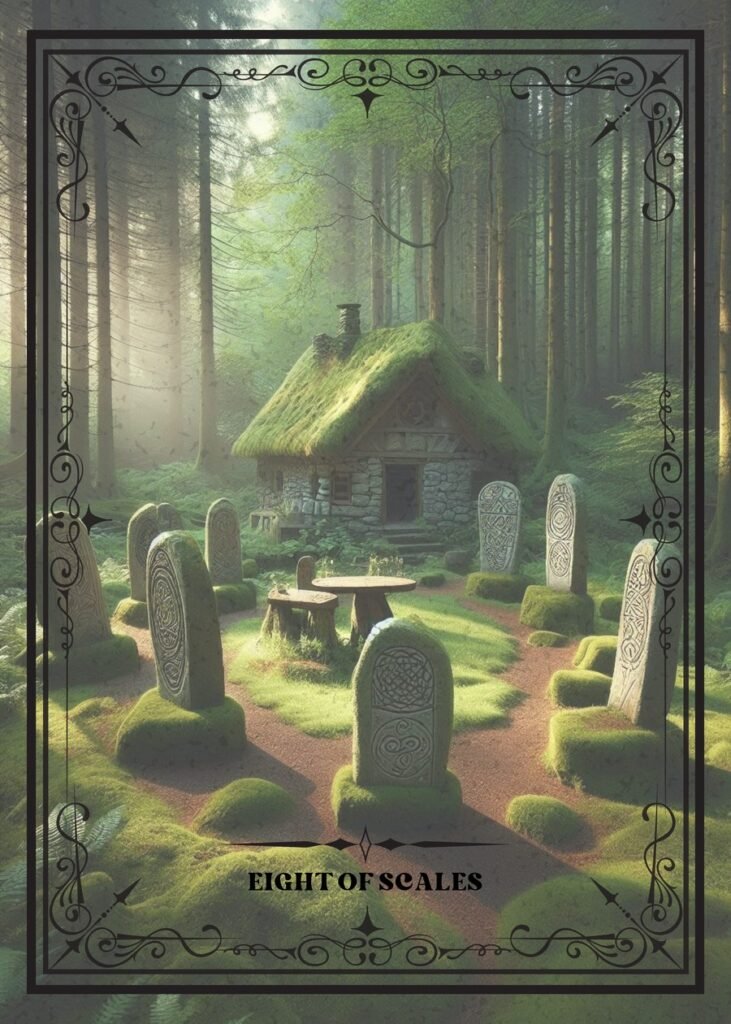
Root — Eight of Scales (the Eight of Pentacles). Carved standing stones around a quiet woodland workshop, with the tools of the craft close at hand. The guidebook gives mastery through repetition and diligence. Reading: this is what the current situation grew from — months of steady, careful work. The card’s shadow side, perfectionism and burnout, is worth a moment’s thought even though it came up upright.
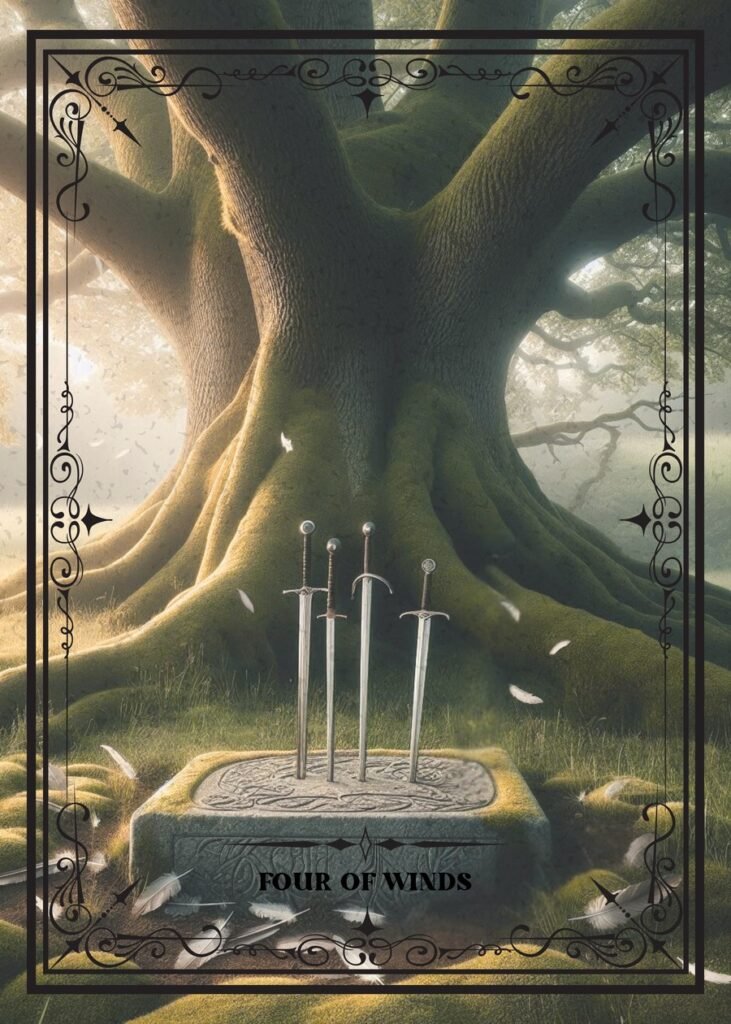
Trunk — Four of Winds (the Four of Swords). Four swords stand in a moss-covered stone beneath an ancient oak. Rest, recovery, contemplation. Reading: where things stand now is a pause. The swords are planted, not raised. This card does not say that the work is wrong; it says the worker needs to stop for a while.
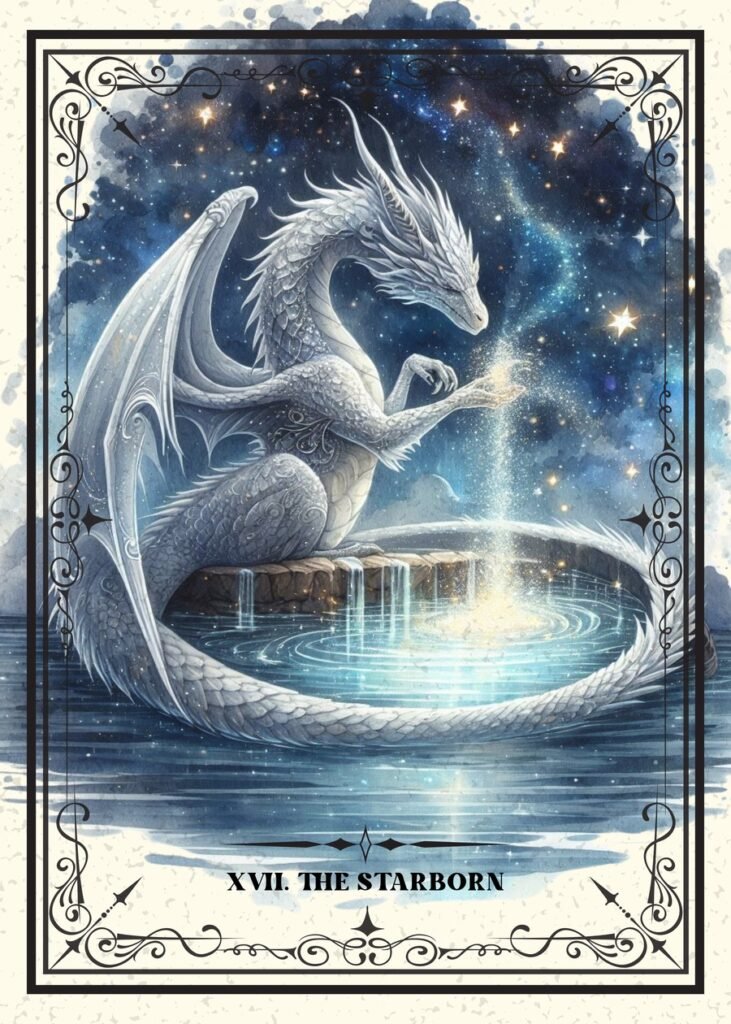
Crown — XVII The Starborn (The Star). A white dragon pours starlight into a still pool under a night sky. Hope, renewal, clarity. Reading: what this is reaching towards is a renewed sense of why the work matters — after the rest, not instead of it.
Reading the three together. The story runs from effort, through a pause, to renewal. Two everyday suit cards lead to a Major Arcana card in the crown, which suggests the bigger theme is not productivity at all but meaning. One action: book a full day off this month, before the next push starts.
Notice what the reading did and did not do. It did not announce what will happen at work. It gave three pictures that held the question long enough for an honest answer to surface.
Should beginners read reversed cards?
A reversed card is one that comes out of the deck upside down. Reading reversals is optional, and many experienced readers never do.
If you decide to read them, remember that a reversal rarely means the opposite of the card. More often it shows the same energy blocked, delayed, turned inward or overdone. Turn half the deck round before you shuffle so reversals can appear. And check your card backs: many printable decks have a title plaque on the back, so you can see which way up a card is before you turn it over. A reversible back — one that looks the same either way up — avoids this.
If you decide not to, read every card upright and let its neighbours show whether the energy is flowing or stuck. A difficult card next to a hopeful one tells a different story from the same card next to another difficult one.
For your first few weeks, reading upright only is the kinder choice. There are already 78 meanings to learn.
Common mistakes with a three card tarot spread
- Asking yes-or-no or “when” questions. Tarot answers these badly. Rephrase into “what” or “how”.
- Choosing positions after you see the cards. Decide first, or the reading becomes whatever you hoped for.
- Reading the book before the picture. The image is where your own response lives. The book is a lantern, not a law.
- Reading each card on its own. Three separate definitions are not a reading. The connections are.
- Redrawing until you like the answer. If you want a second opinion, wait a day and ask a different question.
- Asking the same question over and over. Repeating a reading does not make it more accurate; it just makes it noisier.
- Treating the reading as a verdict. Cards can prompt reflection. They are not a basis for medical, legal, financial or safety decisions.
Tarot as reflection, not prediction
At Open Meaning Cards we treat tarot as a mirror rather than a crystal ball. A three card tarot spread gives you a structured way to look at one question from three angles, and the meaning comes from how you respond to the pictures, not from the cards knowing something you do not.
That is also why the practice is worth keeping. The cards slow you down, give you language for something you have been circling, and end with a choice that is yours. If a reading ever leaves you more anxious than when you started, put the cards away for the day. If you enjoy the reflective side of tarot and would like images with no fixed meanings at all, What Are Metaphorical Associative Cards? explains how they differ.
Which deck to use
Any traditional 78-card deck works for a three card tarot spread and for every variation in this guide. If you are choosing one to learn with, look for clear images, a guidebook that gives both upright and reversed meanings, and a back you can read reversals with.
Our Knotwork Dragon Tarot was made for exactly that. It follows the traditional structure — 22 Major Arcana, four suits of ten and sixteen court cards — retold through dragons and the four Celtic elements, with a 43-page guidebook, five spreads including Root · Trunk · Crown, and a reversible back.
| Edition | What makes it different |
|---|---|
| Beige | Warm cream cards with classic black frames |
| Ash | Cool grey cards with ornate scrollwork and a few different card images |
Both are printable at home on A4 or US Letter paper, and both include every card as a single image for reading on a phone or tablet.
Frequently asked questions
What is the easiest tarot spread for beginners?
A one-card daily draw is the gentlest start, and the three-card spread is the natural next step. Three cards are enough to show how a situation fits together, yet few enough that you can read them in ten minutes without getting lost in meanings.
How do you read a three card tarot spread?
Decide the three positions first, then shuffle and lay three cards from left to right. Look at each picture before anything else, read each card in its position, and then read the three together as one short story. Finish with one thing you will do.
Do I need to memorise all 78 card meanings?
No. Start with the picture and your first response, then check the guidebook for the line that fits your question. Meanings stick through use: after a month of daily draws and a few three-card readings, you will know the cards that matter to you.
Should beginners read reversed cards?
It is entirely optional. Most beginners find it easier to read every card upright for the first few weeks and let the neighbouring cards show whether the energy is flowing or blocked. If you do read reversals later, use a deck with a reversible back.
How do I ask a good tarot question?
Start with “what” or “how”, keep the question about your own part in the situation, and avoid yes-or-no questions or questions about dates. “What would help me see this decision more clearly?” opens a reading; “Will it work out?” closes it.
Can I use a printable tarot deck?
Yes. A printable deck printed at 100% scale on 250–300 gsm matte card stock and cut carefully shuffles and reads like a boxed deck. It also means you can replace a worn or lost card at any time.
Related reading
- How to Print Your Own Card Deck at Home — paper, printer settings, card backs and cutting, step by step.
- 30 Self-Reflection Questions to Use With Any Card Deck — questions to take into your journal after a reading.
- What Are Metaphorical Associative Cards? The Ultimate Beginner’s Guide — how open-image cards differ from tarot.
Closing
A three card tarot spread is small enough to learn in an evening and deep enough to use for years. Choose the positions before you draw, look at the pictures before the book, and read the three cards as one story.
Try it this week with one honest question and Situation · Challenge · Advice. Write down the cards, one sentence about each, and the one thing you will do.