How to Make a Hard Decision: A Card Journaling Exercise

If you are wondering how to make a hard decision, start by accepting that more thinking is rarely what is missing. A decision is usually hard because two things you care about are pulling in different directions, and no list of pros and cons can weigh them for you. This 20-minute exercise slows the question down with three picture cards and a notebook: one card for each path, and one for what you really want.
It is written for anyone standing between two options — a job, a move, a relationship, a project that has to be finished or dropped. You will find the reason hard decisions loop, a three-card layout, a step-by-step journaling routine, prompts for each card, a worked example, and a one-week follow-up for the days after. Coaches can use the same exercise with clients; it works just as well alone at a kitchen table.
Key takeaways
- Knowing how to make a hard decision starts with naming the two things you value that are in conflict, not with gathering more information.
- Three cards do the work: Path A, Path B, and What I really want. Describe each image before you interpret it.
- The third card matters most. It shows what the choice is for, and the options often sort themselves around it.
- “Neither” and “not yet” are real answers, but “not yet” needs a date.
- Take one small step within 48 hours, then read your notes again after a week.
Table of Contents
Why a hard decision feels hard
An easy decision has one option that is plainly better. A hard one has two options that are each better in a different way. Security or freedom. Loyalty or growth. Staying close to people you love or doing the work you want. The difficulty is not a lack of information; it is that two things you value cannot both be fully kept.
That is why the usual tools stall. A pros-and-cons list assumes everything can be measured on one scale. When the items on the list belong to different parts of your life, adding them up produces a number nobody believes, including you.
Fear of loss makes it harder still. Psychologists Daniel Kahneman and Amos Tversky described loss aversion in 1979: what we stand to lose tends to weigh more heavily than what we stand to gain. The details are still debated, but the everyday effect is familiar. Whatever you would have to give up looks larger than whatever you might get, so staying where you are seems safer than it really is.
One piece of research is worth knowing here. The economist Steven Levitt invited people who were stuck on a major life decision to let a coin toss help them choose, then followed up months later. Those who made a change, such as leaving a job or ending a relationship, reported being happier two and six months on than those who kept things as they were. The study relied on volunteers and on self-reported happiness, so it is no instruction to leap. Its modest lesson is this: if you have been stuck for a long time, you are probably undercounting what staying costs.
How picture cards help when a decision will not move
By the time a decision feels hard, you have usually argued both sides so often that you can recite them. The arguments are not wrong. They are simply worn smooth, and going round them again produces nothing new.
An image is a different kind of input. Faced with an open picture — a path, a doorway, a boat on still water — you describe what you see, and what you notice turns out to be about your own situation. This is projection, and it is the whole mechanism: the card has no message, and the meaning comes from you. If the idea is new, What Are Metaphorical Associative Cards? explains how it works.
Two things follow. A card cannot tell you what to do, and nothing here predicts an outcome. What the cards can do is let you hear something you already know, from slightly further away, in words you have not used before. Much of how to make a hard decision is exactly that.
How to make a hard decision with three cards: the layout
Lay three cards in a triangle: two side by side, and one above them.
- Left — Path A. The first option, as it really is.
- Right — Path B. The second option, as it really is.
- Above — What I really want. Not a third option. The thing both options are supposed to serve.



The third card is what separates this from a simple two-paths layout, like the one in How to Use MAC Cards in Coaching. Most decisions are made in service of something: more room, more safety, more meaning, less dread on a Sunday evening. When that something has a clear shape, one path often turns out to lead towards it — or you see that neither does, which is just as useful.
Blind or chosen? Draw the two path cards face down. If you choose them face up, you will pick the attractive image for the option you already favour. Choose the third card face up, slowly, from a spread: the picture that pulls at you when you think “what I really want” is usually telling the truth.
How to make a hard decision in 20 minutes, step by step
You need a deck of open images, a notebook, a pen, a timer and twenty minutes without interruption. Phone in another room.
- Write the decision as two real paths (2 minutes). Not “Should I leave?” but “Path A: stay and ask for a four-day week. Path B: hand in my notice in January.” Both paths must be things you could actually do. If you have more than two options, take the two that keep you awake.
- Lay out the three cards (1 minute). Two face down for the paths, one chosen face up for what you really want. Turn the path cards over.
- Describe Path A (4 minutes). Write what you see: light, weather, distance, what is near, what is missing. Only then ask where this picture touches the option you wrote down.
- Describe Path B (4 minutes). The same, with the same patience. Give the option you like less exactly as much attention as the one you like more.
- Turn to the third card (5 minutes). Describe it, then finish this sentence three different ways: “What I really want is…” Do not edit. The second or third version is usually the honest one.
- Read back and underline (2 minutes). Mark any sentence that surprised you. Notice where your handwriting speeded up, and where your shoulders dropped.
- Choose one small step (2 minutes). Not the decision itself. One action in the next 48 hours that tests or honours what the third card showed: a conversation, a number to look up, an hour blocked in the diary.
Then close the notebook. You are not required to decide today.
Decision-making journal prompts for each card
Use these when the description runs dry. One or two per card is enough.
For Path A and Path B
- What do I notice first, and what do I notice last?
- If I stepped into this picture, where would I be standing a year from now?
- What does this path protect me from?
- What would it cost — and who else would pay?
- What has this image left out?
For “What I really want”
- What in this picture do I want more of?
- When did I last have that, and what was different then?
- Which path moves towards this, even slightly?
- What would I choose if nobody needed an explanation?
- What am I hoping someone else will decide for me?
For the three cards together
- Which card did I want to look away from?
- If these were a friend’s cards, what would seem obvious to me?
- What is the question underneath the question?
For a longer list, 30 Self-Reflection Questions to Use With Any Card Deck has five more on change and decisions.
A worked example
This example is illustrative and does not describe a real person.
The decision. Path A: stay in a secure job she has outgrown. Path B: leave in the spring and work freelance.
Path A — an anchor lying on the sand at the water’s edge, its rope coiled beside it. “It’s heavy, and it isn’t even in the water. It isn’t holding anything. It’s just parked.” Crossing over: “I keep calling this job my security. But I’m not anchored there. I’m stored.”
Path B — a small sailing boat on flat water at dawn. “It’s beautiful, and there’s hardly any wind. One person could handle it. There’s nobody else in the picture.” Crossing over: “Freelance looks calm from here. What frightens me isn’t the risk. It’s being alone with it.”
What I really want — an open window, the curtain lifting. “Air. Something moving through a room that’s already there. I don’t want to leave the house. I want the window open.”
The shift. “Neither path as I wrote it. I want more air in the work I already do, and people around me while I do it. That’s a different question from stay or go.”
Small step. Ask to lead the new project this week, and have coffee with a friend who freelances from a shared studio.
The cards predicted nothing, and they did not choose. They held the shape of each option long enough for a third one to appear.
How to make a hard decision when the answer is “neither” or “not yet”
Sometimes the exercise does not point to Path A or Path B, and that is a result, not a failure.
- Neither. The two options were standing in for something else. Rewrite the paths using what the third card showed, and repeat the exercise in a week.
- Both feel wrong. Look at what each path protects you from. The real decision often sits upstream: a conversation you have been avoiding, or a limit you have not set.
- Not yet. Legitimate when something real is missing — a fact, a date, an answer from another person. Write down exactly what it is and when you will have it. Without a date, “not yet” is a decision to stay that has not been admitted.
- Truly fifty-fifty. If two options are still level after honest reflection, both are liveable, and waiting now costs more than the difference between them. Toss a coin and watch your first reaction as it lands. Relief or disappointment is information, whichever way you then go.
The one-week follow-up
Knowing how to make a hard decision includes knowing what to do in the days afterwards. Insight fades quickly unless something is done with it.
- Day 0. Prop the third card where you will see it — on the desk, by the kettle, as a photo on your phone. Take the small step within 48 hours.
- Day 3. Two lines in the notebook: what did the step show me? Do I feel lighter or heavier?
- Day 7. Read the whole entry again, cold. Ask three things. What still feels true? What was written out of fear? If I had to decide today, which way would I go — and would the first feeling be relief or dread?
Then decide, or set a decision date and tell one person what it is.
One distinction helps with pace. If a choice can be reversed — a course, a trial period, a conversation — decide sooner and learn from doing. If it is hard to undo, take the full week, and take it to someone whose judgement you trust.
Common mistakes when making a hard decision
- Asking “should I?” The question asks for permission. “What do I want, and what will it cost?” asks for clarity.
- Reading the cards as yes or no. A dark image on Path B is not a warning. It is a picture you have feelings about. Describe it.
- Redrawing until you like the card. The card that irritates you is doing its job.
- Deciding at midnight. Tired, hungry and anxious minds choose whatever ends the discomfort fastest. Reflect in the evening if you like; decide in daylight.
- Skipping the description. Going straight to “what it means” brings back the arguments you already know.
- Making one decision carry your whole life. Most choices are smaller and more adjustable than they feel at 2 a.m.
When a decision needs more than a notebook
Picture cards and journaling are a reflective tool, not a psychological assessment, a diagnostic instrument or a substitute for therapy, medical care or professional advice. For decisions with legal, financial or medical consequences, get qualified advice alongside your own reflection. And if a decision involves your safety, or thinking about it leaves you overwhelmed, talk to a professional or to someone you trust before you do anything else.
Which deck to use
Any deck of open images will work. If you are choosing one because you are working out how to make a hard decision, match the deck to where you are stuck:
| If you are stuck on | Deck | Why |
|---|---|---|
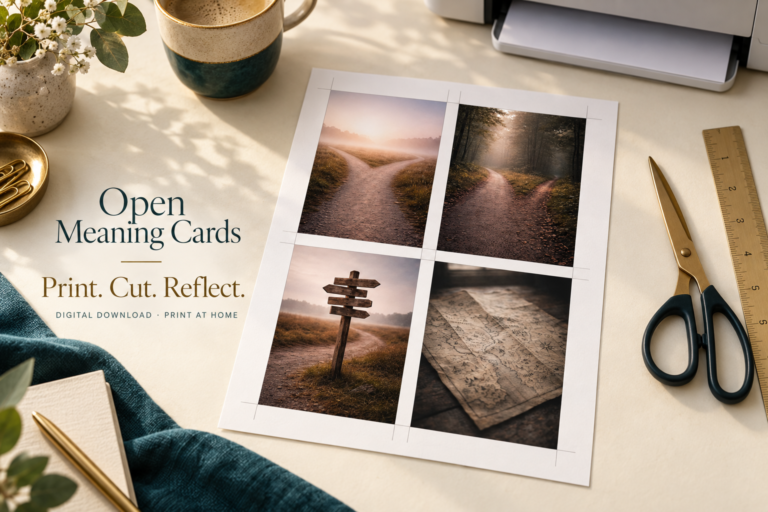
| Choosing between paths | Crossroads | Fifty quiet photographs of roads, doors, bridges and thresholds, in five clusters: The Crossroad, The Block, The Cost, The Resource, The Step |
| Not knowing how you feel about either option | Inner Weather | Images of states rather than scenes; see How to Help Clients Name a Feeling |
| Finding one word for what you want | Words | Fifty plain words to place beside the third card |
| The same arguments going round | Surreal & Fractal | Strange, open images that a rehearsed answer cannot reach |
| A choice that is really about a boundary | Personal Space | Fifty wordless images about room, capacity, closeness and everyday choices |
If the hardest part is working out what you feel about each path, the exercises in How to Help Clients Name a Feeling come first.
Frequently asked questions
How do I make a decision when both options feel wrong?
Start by asking what each option protects you from, because two wrong-feeling options usually mean the real decision is somewhere else. Name what you want the choice to give you, then check whether either path leads there. If neither does, rewrite the options before choosing between them.
How to make a hard decision when you feel completely stuck?
Stop arguing the two sides and change the input. Write the choice as two concrete paths, draw one picture card for each and one for what you really want, and describe the images before you interpret them. Finish with one small step in the next 48 hours instead of the whole decision.
Can journaling help with decisions?
Yes. It is one of the simplest answers to how to make a hard decision, because writing slows your thinking down enough to notice what you have been skipping over, and it leaves a record you can reread a week later with a calmer mind. Journaling works best for decisions when it follows a simple structure — two paths, what you want, one next step — and not an open page.
How do picture cards help with decisions?
They give you something to describe that is not the decision itself. What you notice in an open image reflects your own situation, so a card can bring out a feeling or a wish that the usual arguments hide. The card does not advise or predict; the meaning comes from you.
How long should I take to decide?
As long as it takes to get any information that is truly missing, and not much longer. For reversible choices, decide quickly and adjust as you learn. For choices that are hard to undo, give yourself a set period — a week is often enough — and name the date in advance.
What if my gut and my head disagree?
Treat both as information. Your head is usually reporting risks and obligations; your gut is usually reporting what you want or fear. Write down what each one is trying to protect, and look for the option, or the adjustment to an option, that takes both seriously.
Related reading
- 30 Self-Reflection Questions to Use With Any Card Deck — thirty questions in six themes, including change and decisions.
- How to Help Clients Name a Feeling (With Picture Cards) — seven exercises for when you cannot tell what you feel about an option.
- What Are Metaphorical Associative Cards? The Ultimate Beginner’s Guide — how open-image cards work, and why they have no fixed meanings.
Closing
Learning how to make a hard decision is mostly learning to ask a better question. Not “which option is right?” but “what do I really want, and which path moves towards it?” Three cards and twenty minutes will not decide for you. They will make it much harder to keep pretending you do not know.
Write down the two paths tonight. Draw the cards tomorrow, in daylight, and take one small step before the week is out.